Word Explanation
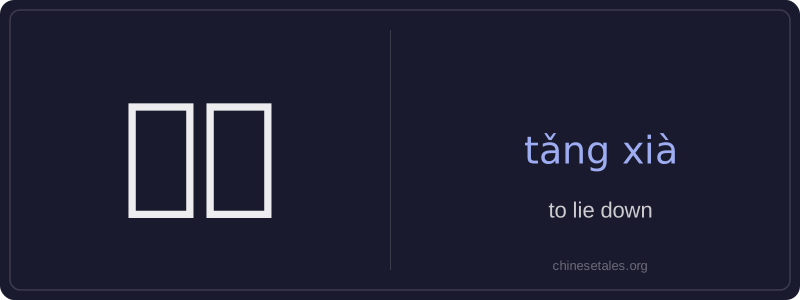
‘躺下’ (tǎng xià) is a separable verb meaning ‘to lie down’ — literally ‘to stretch out + downward’. The character 躺 (tǎng) means ‘to lie (horizontally)’, and 下 (xià) functions as a directional complement indicating movement or change of position toward a lower state. Together, they describe the physical action of lowering one’s body onto a surface — typically a bed, couch, or floor — to rest or sleep.
This verb is commonly used in daily routines, health-related instructions (e.g., after exercise or illness), and caregiving contexts. It implies intentional, full-body reclining — distinct from sitting or leaning. Unlike the standalone verb 躺, which can be used without an object (e.g., 他躺了), 躺下 emphasizes the *completion* of the action: transitioning into a lying position. It often appears with time or manner adverbs (e.g., 马上躺下, 安静地躺下) and may take aspect markers like 了 or 着.
Example Sentences
Related Words
国语
‘Guó yǔ’ literally means 'national language'—
面条
‘面条’ (miàn tiáo) literally means ‘flour str
无论谁
‘无论谁’ (wú lùn shéi) is a pronoun meaning
不对
不对 (bù duì) literally combines 不 (bù), meani
外语
‘外语’ literally means ‘outside language’ —
认同
‘认同’ (tóng rèn) is a verb meaning ‘to ident
中学
'Zhōngxué' literally combines 'zhōng' (middle)
背后
背后 literally means 'back + behind' and functions