Word Explanation
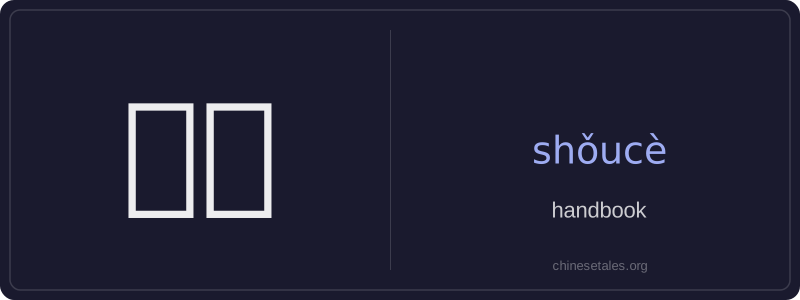
‘手册’ (shǒucè) is a compound noun meaning ‘handbook’ — a concise, practical reference guide designed for quick consultation. The first character 手 (shǒu) means ‘hand’, suggesting something held and used directly; the second character 册 (cè) means ‘booklet’ or ‘volume’, historically referring to bound bamboo strips or paper pages. Together, they evoke the idea of a compact, portable book meant for hands-on use — not for deep reading, but for immediate access to instructions, procedures, or key information.
This word appears frequently in educational, technical, workplace, and consumer contexts: user manuals for appliances, safety handbooks for factories, study handbooks for exams, or travel handbooks for tourists. It carries a neutral-to-formal register and implies utility and organization. Unlike general ‘books’ (书), a 手册 is purpose-built, often illustrated, and structured for scanning rather than linear reading.
Example Sentences
Related Words
国语
‘Guó yǔ’ literally means 'national language'—
面条
‘面条’ (miàn tiáo) literally means ‘flour str
无论谁
‘无论谁’ (wú lùn shéi) is a pronoun meaning
不对
不对 (bù duì) literally combines 不 (bù), meani
外语
‘外语’ literally means ‘outside language’ —
认同
‘认同’ (tóng rèn) is a verb meaning ‘to ident
中学
'Zhōngxué' literally combines 'zhōng' (middle)
背后
背后 literally means 'back + behind' and functions