Word Explanation
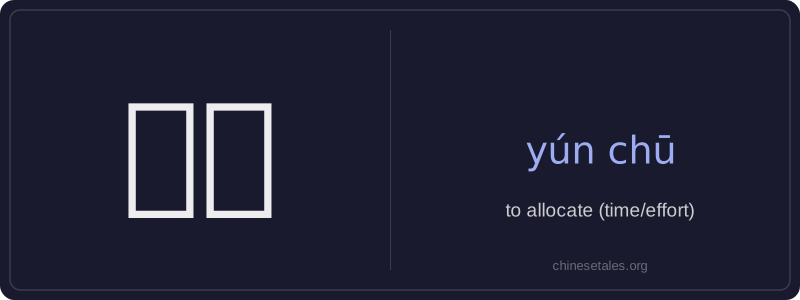
'匀出' (yún chū) is a compound verb meaning 'to allocate' or 'to set aside' a portion of something limited—most commonly time, effort, money, or energy—for a specific purpose. The first character 匀 (yún) means 'to distribute evenly' or 'to apportion', evoking balance and fairness; the second character 出 (chū) means 'to come out' or 'to produce', indicating the act of removing or designating something from a larger whole. Together, they convey the intentional, often careful, act of carving out a share from one’s existing resources.
This verb is frequently used in contexts involving personal management—like scheduling, budgeting, or prioritizing—and carries a subtle nuance of sacrifice or conscious trade-off. It implies that the resource being allocated is scarce or valuable, and the speaker is making a deliberate choice to divert part of it. While neutral in register, it’s more common in spoken and written Mandarin than formal bureaucratic language, and rarely appears with physical objects unless metaphorically extended (e.g., '匀出空间').
Example Sentences
Related Words
国语
‘Guó yǔ’ literally means 'national language'—
无论谁
‘无论谁’ (wú lùn shéi) is a pronoun meaning
面条
‘面条’ (miàn tiáo) literally means ‘flour str
外语
‘外语’ literally means ‘outside language’ —
不对
不对 (bù duì) literally combines 不 (bù), meani
认为
‘认为’ (rèn wéi) is a transitive verb meaning
认同
‘认同’ (tóng rèn) is a verb meaning ‘to ident
中学
'Zhōngxué' literally combines 'zhōng' (middle)