Word Explanation
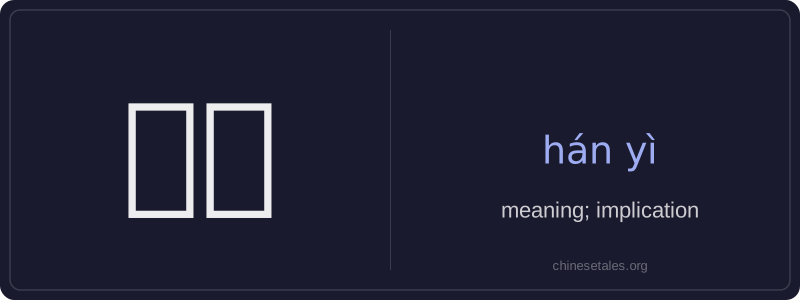
‘含义’ (hán yì) is a noun meaning ‘meaning’ or ‘implication’—the idea, significance, or underlying message conveyed by a word, phrase, symbol, or action. It combines the characters 含 (hán), meaning ‘to contain’ or ‘to hold within’, and 义 (yì), meaning ‘meaning’, ‘righteousness’, or ‘moral principle’. Together, they literally suggest ‘that which is contained within’—a compact, conceptual core of significance.
This word is commonly used in academic, literary, and everyday contexts when discussing language, signs, gestures, or cultural practices. Unlike the more basic word 意思 (yì si), 含义 often implies depth, intentionality, or subtlety—for example, the symbolic meaning of a gesture or the philosophical weight behind a proverb. It appears frequently in explanations, analyses, and discussions where interpretation matters, such as in literature class, translation work, or cross-cultural communication.
Example Sentences
Related Words
国语
‘Guó yǔ’ literally means 'national language'—
无论谁
‘无论谁’ (wú lùn shéi) is a pronoun meaning
外语
‘外语’ literally means ‘outside language’ —
面条
‘面条’ (miàn tiáo) literally means ‘flour str
不对
不对 (bù duì) literally combines 不 (bù), meani
认为
‘认为’ (rèn wéi) is a transitive verb meaning
认同
‘认同’ (tóng rèn) is a verb meaning ‘to ident
中学
'Zhōngxué' literally combines 'zhōng' (middle)