Word Explanation
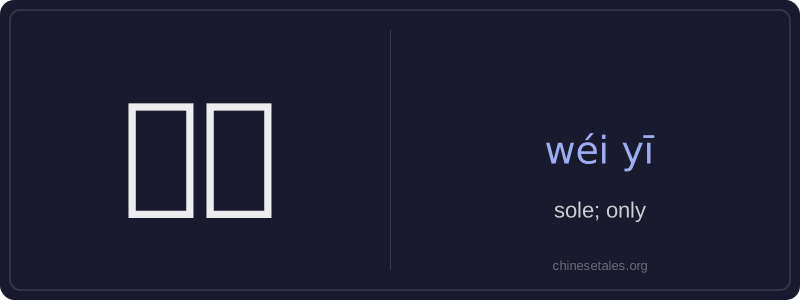
'唯一' (wéi yī) is an adjective meaning 'sole' or 'only', emphasizing singularity and exclusivity. The character 唯 (wéi) conveys 'only' or 'solely', often used to stress uniqueness or exclusiveness, while 一 (yī) literally means 'one' — together they form a compound that underscores that there is exactly one of something, with no alternatives or exceptions. It carries a formal, slightly literary tone and is commonly used in written Chinese and formal speech.
This word frequently modifies nouns directly (e.g., 唯一的机会, 'the only opportunity') and can also function predicatively after 是 (shì), as in 这是唯一的办法 ('This is the only solution'). It’s stronger and more emphatic than just 一个 or 只有, implying irreplaceability or absolute singularity — not merely 'one among many', but 'the one and only'. It’s often found in contexts involving choice, identity, responsibility, or uniqueness in daily life, education, or official communication.
Example Sentences
Related Words
国语
‘Guó yǔ’ literally means 'national language'—
无论谁
‘无论谁’ (wú lùn shéi) is a pronoun meaning
外语
‘外语’ literally means ‘outside language’ —
面条
‘面条’ (miàn tiáo) literally means ‘flour str
不对
不对 (bù duì) literally combines 不 (bù), meani
认为
‘认为’ (rèn wéi) is a transitive verb meaning
认同
‘认同’ (tóng rèn) is a verb meaning ‘to ident
中学
'Zhōngxué' literally combines 'zhōng' (middle)