Word Explanation
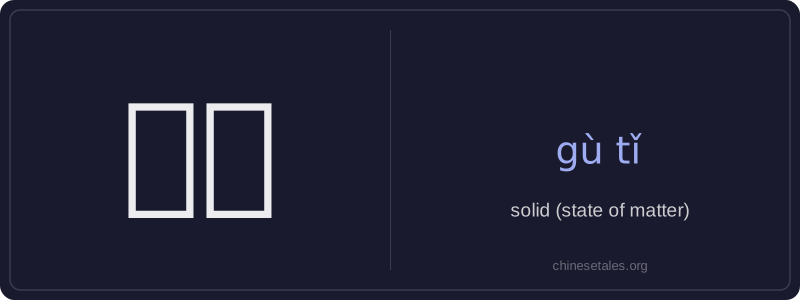
'固体' (gùtǐ) literally means 'fixed form' — '固' conveys firmness, stability, or immutability, while '体' means 'body' or 'substance'. Together, they refer to the solid state of matter: a physical state in which substances maintain both definite shape and volume due to tightly packed, minimally moving particles. It is one of the three classical states of matter, alongside 液体 (liquid) and 气体 (gas). In everyday usage, 固体 appears frequently in science education, cooking (e.g., distinguishing solid fats from oils), material descriptions, and environmental contexts (e.g., plastic waste as solid pollutants).
This term is formal and technical; it rarely appears in casual conversation unless discussing physics, chemistry, or health-related topics like dietary fiber ('膳食纤维', a type of solid food component). Unlike colloquial terms such as '硬东西' (hard thing), 固体 carries precise scientific meaning and is used consistently across textbooks, lab reports, and official documents.
Example Sentences
Related Words
国语
‘Guó yǔ’ literally means 'national language'—
无论谁
‘无论谁’ (wú lùn shéi) is a pronoun meaning
外语
‘外语’ literally means ‘outside language’ —
面条
‘面条’ (miàn tiáo) literally means ‘flour str
不对
不对 (bù duì) literally combines 不 (bù), meani
认为
‘认为’ (rèn wéi) is a transitive verb meaning
认同
‘认同’ (tóng rèn) is a verb meaning ‘to ident
中学
'Zhōngxué' literally combines 'zhōng' (middle)