Word Explanation
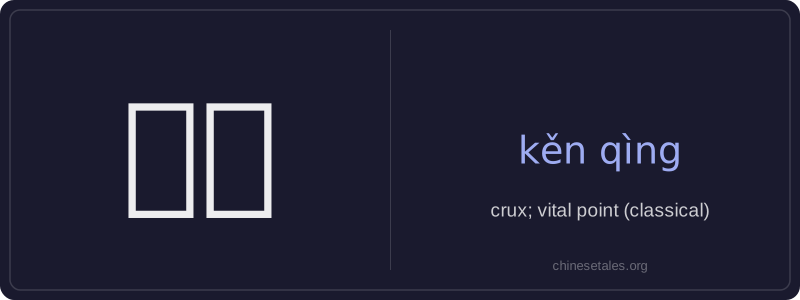
‘肯綮’ (kěn qìng) is a classical Chinese literary term meaning ‘the crux,’ ‘the vital point,’ or ‘the essential juncture.’ It originally refers to the anatomical junction where muscle meets bone — specifically, the tendon-muscle attachment (肯) and the tough connective tissue around joints (綮). This precise, almost surgical imagery conveys a point of critical importance, difficulty, or insight — not just any key point, but the deepest, most decisive one in a complex situation.
The term appears mainly in formal, scholarly, or literary contexts — essays, philosophical texts, or refined speech — and carries a tone of intellectual depth and precision. It is rarely used in casual conversation. Because both characters are rare and carry strong classical flavor, learners should treat 肯綮 as a fixed, unanalyzable compound noun rather than trying to interpret each character separately in modern usage. Its power lies in evoking a moment of penetrating understanding or an irreducible core problem.
Example Sentences
Related Words
国语
‘Guó yǔ’ literally means 'national language'—
面条
‘面条’ (miàn tiáo) literally means ‘flour str
背后
背后 literally means 'back + behind' and functions
无论谁
‘无论谁’ (wú lùn shéi) is a pronoun meaning
中学
'Zhōngxué' literally combines 'zhōng' (middle)
外语
‘外语’ literally means ‘outside language’ —
认同
‘认同’ (tóng rèn) is a verb meaning ‘to ident
不对
不对 (bù duì) literally combines 不 (bù), meani