Word Explanation
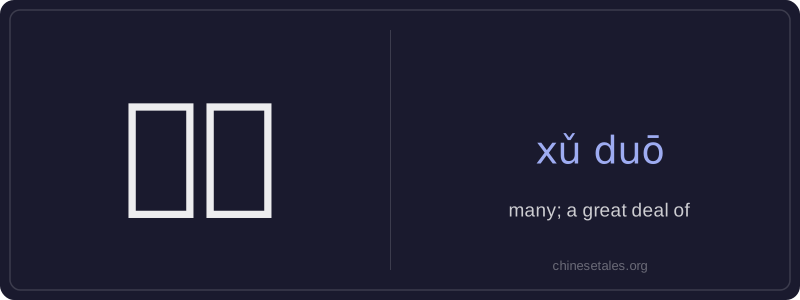
Many learners assume 许多 (xǔ duō) functions like a noun meaning 'many things,' but it’s actually an adjective that modifies nouns directly—similar to 'many' or 'a great deal of' in English. The character 许 (xǔ) originally means 'to permit' or 'to allow,' and 多 (duō) means 'many' or 'much'; together, they form an idiomatic compound emphasizing abundance or large quantity. Unlike the numeral-based phrase 一些 (yī xiē), 许多 carries a stronger, more emphatic sense of quantity and is commonly used in both spoken and written Chinese.
This word appears frequently when describing countable nouns—especially animals, people, objects, or events—and often appears before the noun without measure words (e.g., 许多鸟, not *许多一只鸟). It’s neutral in register, suitable for everyday conversation as well as formal writing, and avoids the numerical precision of phrases like 三十多个 (sān shí duō gè). It pairs naturally with verbs like 有 (yǒu), 看见 (kàn jiàn), or 养 (yǎng) to express observation, possession, or experience involving large numbers.
Example Sentences
Related Words
国语
‘Guó yǔ’ literally means 'national language'—
面条
‘面条’ (miàn tiáo) literally means ‘flour str
无论谁
‘无论谁’ (wú lùn shéi) is a pronoun meaning
不对
不对 (bù duì) literally combines 不 (bù), meani
外语
‘外语’ literally means ‘outside language’ —
认同
‘认同’ (tóng rèn) is a verb meaning ‘to ident
中学
'Zhōngxué' literally combines 'zhōng' (middle)
背后
背后 literally means 'back + behind' and functions