Word Explanation
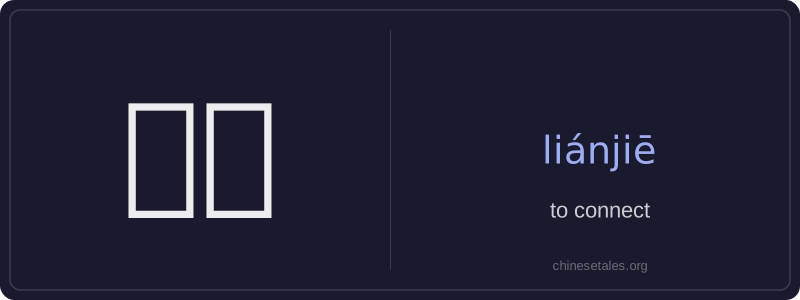
连接 (liánjiē) is a verb meaning 'to connect' or 'to link'—physically, electronically, logically, or abstractly. The first character 连 (lián) means 'to join together in sequence or continuity', while 接 (jiē) means 'to receive', 'to meet', or 'to attach'. Together, they emphasize the action of establishing a functional or structural link between two or more things. It’s commonly used in contexts involving infrastructure (e.g., roads, bridges), technology (e.g., Wi-Fi, cables), transportation (e.g., transit lines), and even relationships or ideas.
This word often appears in both formal and everyday speech, especially when describing how systems, places, or people are linked. Unlike the more casual 接 (jiē) alone, 连接 stresses intentionality and functionality in the connection. It can be used transitively (with an object) or intransitively, and frequently appears in compound nouns like 连接线 (connection cable) or 连接点 (connection point).
Example Sentences
Related Words
国语
‘Guó yǔ’ literally means 'national language'—
面条
‘面条’ (miàn tiáo) literally means ‘flour str
无论谁
‘无论谁’ (wú lùn shéi) is a pronoun meaning
不对
不对 (bù duì) literally combines 不 (bù), meani
外语
‘外语’ literally means ‘outside language’ —
认同
‘认同’ (tóng rèn) is a verb meaning ‘to ident
中学
'Zhōngxué' literally combines 'zhōng' (middle)
背后
背后 literally means 'back + behind' and functions