Word Explanation
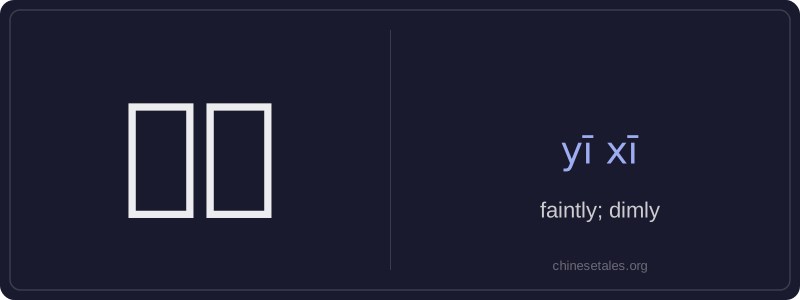
‘依稀’ is an adverb meaning ‘faintly’ or ‘dimly’, used to describe something barely perceptible—whether a sight, sound, memory, or feeling. The character 依 suggests ‘relying on’ or ‘following closely’, while 稀 means ‘sparse’, ‘rare’, or ‘thin’. Together, they evoke the sense of something present but indistinct, like a distant echo or a half-remembered image. It often conveys nostalgia, uncertainty, or sensory ambiguity.
This word appears frequently in literary and descriptive contexts—especially when evoking memories, hazy visions, or subtle impressions. It’s commonly placed before verbs (e.g., 依稀记得, ‘vaguely remember’) or adjectives (e.g., 依稀可见, ‘faintly visible’). While it can modify nouns in fixed phrases (e.g., 依稀的轮廓), it functions primarily as an adverbial modifier. It carries a gentle, poetic tone and is rarely used in casual speech or technical writing.
Example Sentences
Related Words
国语
‘Guó yǔ’ literally means 'national language'—
面条
‘面条’ (miàn tiáo) literally means ‘flour str
无论谁
‘无论谁’ (wú lùn shéi) is a pronoun meaning
不对
不对 (bù duì) literally combines 不 (bù), meani
外语
‘外语’ literally means ‘outside language’ —
认同
‘认同’ (tóng rèn) is a verb meaning ‘to ident
中学
'Zhōngxué' literally combines 'zhōng' (middle)
背后
背后 literally means 'back + behind' and functions