Word Explanation
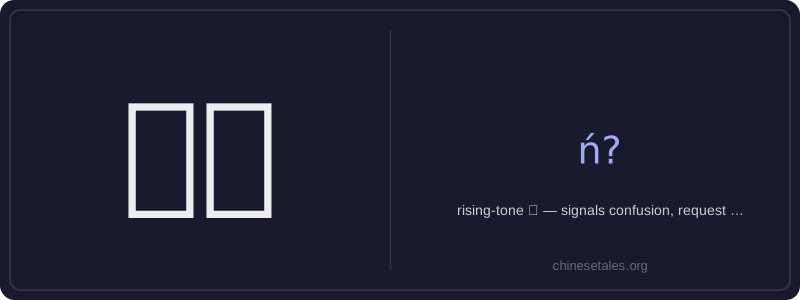
‘嗯?’ (ń?) is a rising-tone interjection formed by the syllable ‘嗯’ pronounced with a high-rising tone (second tone), followed by the question mark. Though written with a single character, the tone shift and punctuation transform it into a distinct pragmatic particle—not a lexical word but a discourse marker. It signals momentary cognitive disengagement: the listener heard something but didn’t fully process it, prompting gentle clarification without impatience or confrontation.
This expression is highly context-dependent and relies entirely on intonation and timing. It’s commonly used in informal spoken Chinese during face-to-face or phone conversations—never in formal writing or speeches. Unlike the flat-tone ‘嗯’ (ǹg, meaning ‘yes’), the rising ‘嗯?’ conveys neither agreement nor disagreement, but rather a soft, nonjudgmental pause inviting repetition or elaboration. Its nuance lies in its lightness: it preserves rapport while flagging a gap in understanding.
Example Sentences
Related Words
国语
‘Guó yǔ’ literally means 'national language'—
无论谁
‘无论谁’ (wú lùn shéi) is a pronoun meaning
外语
‘外语’ literally means ‘outside language’ —
面条
‘面条’ (miàn tiáo) literally means ‘flour str
不对
不对 (bù duì) literally combines 不 (bù), meani
认为
‘认为’ (rèn wéi) is a transitive verb meaning
认同
‘认同’ (tóng rèn) is a verb meaning ‘to ident
中学
'Zhōngxué' literally combines 'zhōng' (middle)