Word Explanation
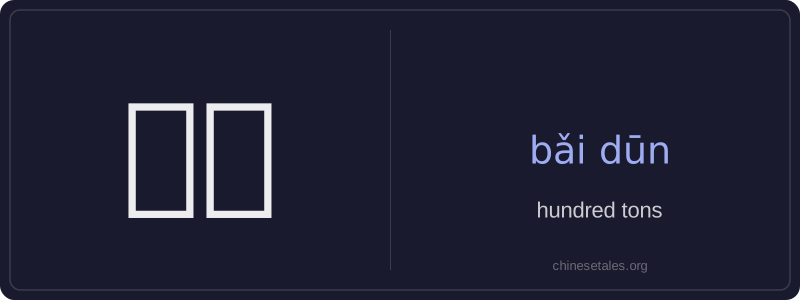
‘百吨’ (bǎi dūn) is a compound noun meaning ‘hundred tons’, formed by combining the numeral ‘百’ (bǎi, ‘hundred’) and the unit of mass ‘吨’ (dūn, ‘ton’, equivalent to 1,000 kilograms). Unlike English, Chinese does not use plural forms or articles with measure words like this — ‘百吨’ stands alone as a quantified noun phrase and functions as a single unit in sentences.
This term appears primarily in technical, industrial, or logistical contexts — such as describing cargo weight, mining output, or environmental metrics (e.g., carbon emissions). It’s rarely used in casual speech; instead, people often say ‘一百多吨’ (more than one hundred tons) or approximate with ‘上百吨’ (‘over one hundred tons’) for emphasis or vagueness. Note that ‘吨’ is the standard metric ton in mainland China and differs from the imperial ton used in some English-speaking countries.
Example Sentences
Related Words
国语
‘Guó yǔ’ literally means 'national language'—
无论谁
‘无论谁’ (wú lùn shéi) is a pronoun meaning
外语
‘外语’ literally means ‘outside language’ —
面条
‘面条’ (miàn tiáo) literally means ‘flour str
不对
不对 (bù duì) literally combines 不 (bù), meani
认为
‘认为’ (rèn wéi) is a transitive verb meaning
认同
‘认同’ (tóng rèn) is a verb meaning ‘to ident
中学
'Zhōngxué' literally combines 'zhōng' (middle)