Word Explanation
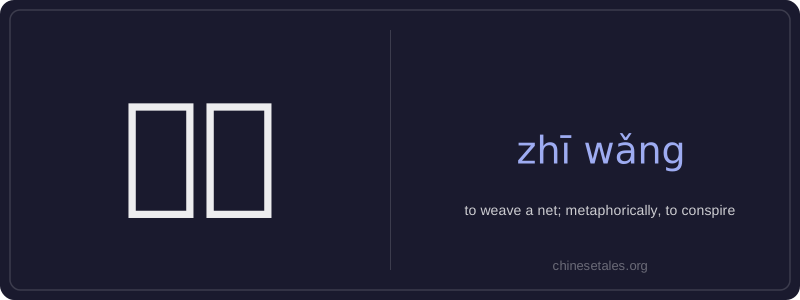
'织网' literally means 'to weave a net'—combining 织 (zhī), meaning 'to weave' or 'to knit', and 网 (wǎng), meaning 'net' or 'web'. It describes the physical act of interlacing threads or fibers to create a net, commonly associated with fishing nets, spider webs, or textile crafts. In traditional contexts, it often evokes images of artisans or spiders performing meticulous, repetitive work.
Figuratively, '织网' is widely used in modern Chinese to mean 'to conspire' or 'to plot secretly', especially when people collaborate covertly to manipulate outcomes—such as political intrigue, business schemes, or social manipulation. This metaphor draws directly from the idea of carefully constructing hidden connections, like threads in a web. While neutral in literal use, the figurative sense carries negative connotations and appears frequently in news reports, literature, and formal speech.
Example Sentences
Related Words
国语
‘Guó yǔ’ literally means 'national language'—
无论谁
‘无论谁’ (wú lùn shéi) is a pronoun meaning
外语
‘外语’ literally means ‘outside language’ —
面条
‘面条’ (miàn tiáo) literally means ‘flour str
认同
‘认同’ (tóng rèn) is a verb meaning ‘to ident
违规
违规 (wéi guī) literally means 'to violate rules
亲笔
‘亲笔’ literally means ‘one’s own hand’—comb
不对
不对 (bù duì) literally combines 不 (bù), meani