Word Explanation
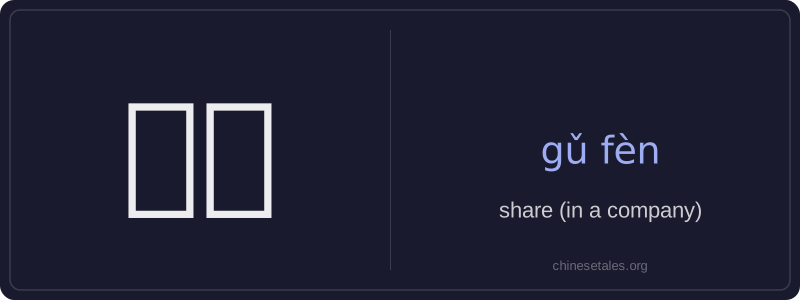
股份 (gǔ fèn) literally combines 股 (gǔ), meaning 'share' or 'segment', and 份 (fèn), meaning 'portion' or 'share'—together forming the financial term 'share' in a company. It refers to a unit of ownership in a joint-stock company, representing both equity stake and rights to dividends and voting. Unlike physical assets, 股份 is intangible and legally registered; it’s commonly bought and sold on stock exchanges.
This term appears frequently in business, finance, and legal contexts—for example, when discussing shareholding ratios, equity transfers, or corporate restructuring. It’s distinct from personal property or commodities: 股份 reflects proportional control and financial interest, not physical possession. While often used with numbers (e.g., 1000 股份) or modifiers like 上市 (listed) or 国有 (state-owned), it’s typically uncountable without a classifier like '股' (e.g., 一股股份). Native speakers usually say 股 rather than 股份 in casual speech when referring to individual shares.
Example Sentences
Related Words
国语
‘Guó yǔ’ literally means 'national language'—
无论谁
‘无论谁’ (wú lùn shéi) is a pronoun meaning
外语
‘外语’ literally means ‘outside language’ —
面条
‘面条’ (miàn tiáo) literally means ‘flour str
认同
‘认同’ (tóng rèn) is a verb meaning ‘to ident
违规
违规 (wéi guī) literally means 'to violate rules
亲笔
‘亲笔’ literally means ‘one’s own hand’—comb
不对
不对 (bù duì) literally combines 不 (bù), meani