Word Explanation
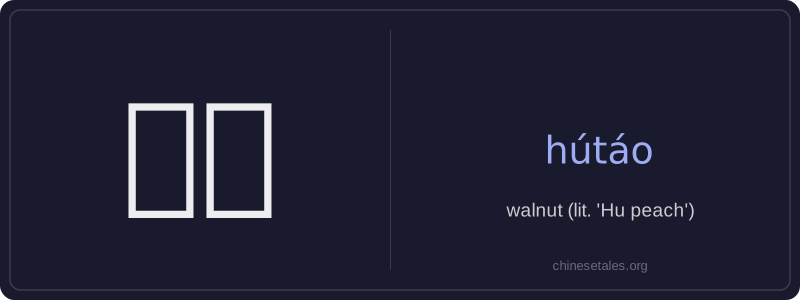
‘Hútáo’ literally means ‘Hu peach’, reflecting its historical introduction to China from Central Asia (the ancient ‘Western Regions’ or ‘Xīyù’, sometimes referred to as ‘Hú’ lands) — though it is not a true peach. The character 胡 (hú) historically denoted non-Han ethnic groups or foreign origins, while 桃 (táo) means ‘peach’, likely used here because the walnut’s wrinkled, hard-shelled fruit resembles a peach pit in shape and texture. Today, 胡桃 refers specifically to the common edible walnut (Juglans regia), widely consumed for its nutritious kernel.
This word is used in everyday contexts — cooking, nutrition, botany, and grocery shopping — and appears in compound terms like 胡桃仁 (hútáo rén, ‘walnut kernel’) and 胡桃木 (hútáo mù, ‘walnut wood’). It is distinct from 山核桃 (shānhétáo, ‘hickory’), which is smaller and native to eastern China. While sometimes shortened colloquially to 核桃 (hétáo), 胡桃 remains the standard literary and botanical term emphasizing origin.
Example Sentences
Related Words
国语
‘Guó yǔ’ literally means 'national language'—
无论谁
‘无论谁’ (wú lùn shéi) is a pronoun meaning
外语
‘外语’ literally means ‘outside language’ —
面条
‘面条’ (miàn tiáo) literally means ‘flour str
认同
‘认同’ (tóng rèn) is a verb meaning ‘to ident
短袜
‘短袜’ (duǎn wà) literally means ‘short sock
违规
违规 (wéi guī) literally means 'to violate rules
亲笔
‘亲笔’ literally means ‘one’s own hand’—comb