Word Explanation
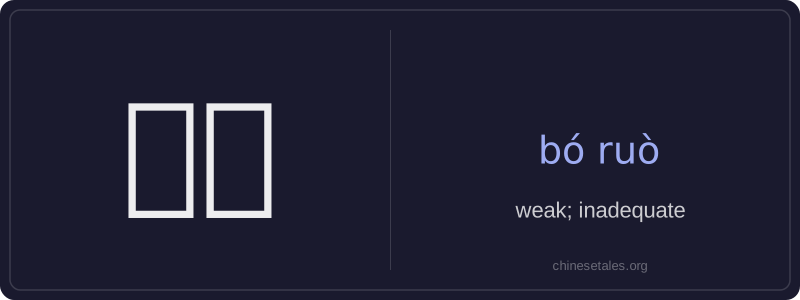
薄弱 (bó ruò) is an adjective meaning 'weak' or 'inadequate', often describing something lacking strength, capacity, or development—especially in abstract domains like skills, systems, foundations, or physical constitution. The character 薄 (bó) originally means 'thin' or 'shallow', suggesting insufficiency or lack of depth; 弱 (ruò) means 'weak' or 'feeble'. Together, they intensify the sense of deficiency—not just physical frailty, but structural, functional, or systemic weakness.
This word is commonly used in formal or semi-formal contexts: education (e.g., a薄弱 foundation in math), healthcare (e.g., a薄弱 immune system), economics (e.g.,薄弱 infrastructure), or personal development (e.g.,薄弱 self-discipline). It carries a neutral-to-slightly-negative connotation and is rarely used for temporary or emotional states—unlike 虚 (xū) or 懦弱 (nuòruò). It typically modifies nouns directly or follows 是 (shì) in predicate position.
Example Sentences
Related Words
国语
‘Guó yǔ’ literally means 'national language'—
无论谁
‘无论谁’ (wú lùn shéi) is a pronoun meaning
外语
‘外语’ literally means ‘outside language’ —
亲笔
‘亲笔’ literally means ‘one’s own hand’—comb
面条
‘面条’ (miàn tiáo) literally means ‘flour str
认同
‘认同’ (tóng rèn) is a verb meaning ‘to ident
短袜
‘短袜’ (duǎn wà) literally means ‘short sock
违规
违规 (wéi guī) literally means 'to violate rules