Word Explanation
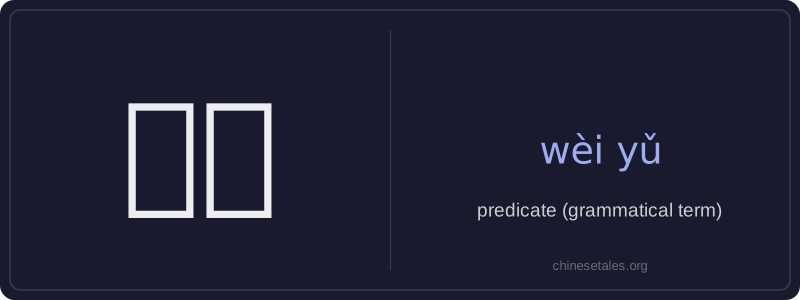
In Chinese grammar, wèiyǔ (谓语) refers to the predicate — the part of a sentence that expresses what the subject does, experiences, or is. It typically follows the subject and includes verbs, adjectives, noun phrases, or stative expressions. The character wèi (谓) originally means 'to say' or 'to state', reflecting the predicate’s role in stating something about the subject; yǔ (语) means 'speech' or 'language', reinforcing its function as a linguistic unit conveying information.
The predicate is essential in forming complete sentences and can be simple (e.g., 是 ‘is’, 在 ‘is at’) or complex (e.g., verb phrases like 正在看书 ‘is reading’). Unlike English, Chinese predicates don’t require inflection for tense or person, relying instead on aspect particles (e.g., 了, 过) and context. Learners often mistakenly treat the predicate as merely the verb — but it encompasses the entire clause that affirms, describes, or locates the subject.
Example Sentences
Related Words
国语
‘Guó yǔ’ literally means 'national language'—
无论谁
‘无论谁’ (wú lùn shéi) is a pronoun meaning
不对
不对 (bù duì) literally combines 不 (bù), meani
外语
‘外语’ literally means ‘outside language’ —
违规
违规 (wéi guī) literally means 'to violate rules
亲笔
‘亲笔’ literally means ‘one’s own hand’—comb
我的
我的 (wǒ de) is a possessive pronoun meaning 'my'
面条
‘面条’ (miàn tiáo) literally means ‘flour str