Word Explanation
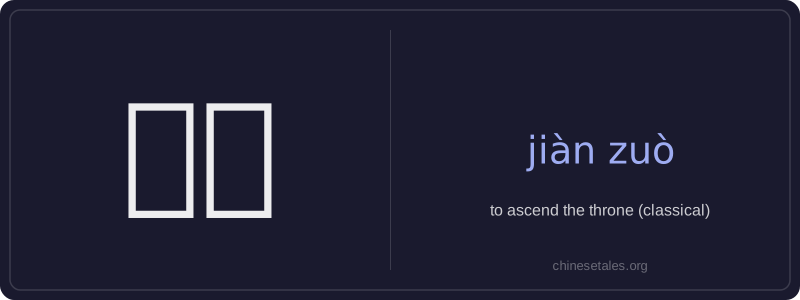
‘践祚’ is a classical Chinese verb meaning ‘to ascend the throne’—specifically, the formal act of a new emperor assuming imperial power after the death or abdication of the previous ruler. The character 践 (jiàn) means ‘to step on’ or ‘to undertake’, conveying the idea of stepping onto the throne as a symbolic and ritual act; 祚 (zuò) refers to the ‘divine mandate’ or ‘imperial legitimacy’—the heavenly-ordained right to rule. Together, the term emphasizes both the physical accession and the moral-political authority conferred by heaven.
This expression appears almost exclusively in historical texts, official chronicles, and literary works describing dynastic transitions in imperial China. It carries strong connotations of legitimacy, ritual propriety, and Confucian political philosophy. Modern usage is extremely rare outside scholarly, historical, or highly formal rhetorical contexts—never in everyday speech or contemporary news. Learners should recognize it as a fixed, archaic compound requiring knowledge of classical syntax and historical context.
Example Sentences
Related Words
国语
‘Guó yǔ’ literally means 'national language'—
无论谁
‘无论谁’ (wú lùn shéi) is a pronoun meaning
不对
不对 (bù duì) literally combines 不 (bù), meani
外语
‘外语’ literally means ‘outside language’ —
违规
违规 (wéi guī) literally means 'to violate rules
亲笔
‘亲笔’ literally means ‘one’s own hand’—comb
我的
我的 (wǒ de) is a possessive pronoun meaning 'my'
短袜
‘短袜’ (duǎn wà) literally means ‘short sock