Word Explanation
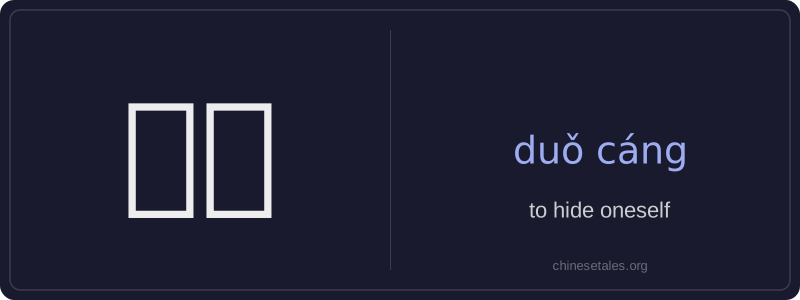
躲藏 is a compound verb meaning 'to hide oneself' — often to avoid being seen, found, or caught. The first character 躲 (duǒ) means 'to dodge' or 'to evade', emphasizing the act of avoiding detection; the second character 藏 (cáng) means 'to conceal' or 'to store away', stressing the state of being hidden. Together, they form a tightly bound, commonly used verb that implies intentional, often temporary, concealment — not just passive hiding but active effort to remain unseen.
This word appears frequently in contexts involving animals evading predators (e.g., rabbits hiding in burrows), children playing hide-and-seek, or people avoiding danger or embarrassment. It carries a neutral-to-slightly urgent tone and is more literary or formal than the simpler verb 躲 (duǒ) alone. While 藏 can also mean 'to store' (e.g., 藏书 — 'to store books'), in 躲藏 it exclusively conveys physical or visual concealment of a person or animal.
Example Sentences
Related Words
国语
‘Guó yǔ’ literally means 'national language'—
无论谁
‘无论谁’ (wú lùn shéi) is a pronoun meaning
不对
不对 (bù duì) literally combines 不 (bù), meani
外语
‘外语’ literally means ‘outside language’ —
违规
违规 (wéi guī) literally means 'to violate rules
亲笔
‘亲笔’ literally means ‘one’s own hand’—comb
我的
我的 (wǒ de) is a possessive pronoun meaning 'my'
短袜
‘短袜’ (duǎn wà) literally means ‘short sock