Word Explanation
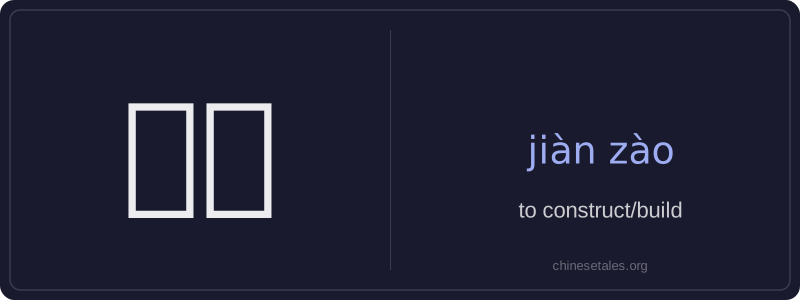
建造 (jiàn zào) is a compound verb meaning 'to construct' or 'to build,' typically referring to the physical creation of structures such as buildings, bridges, roads, or infrastructure. The first character 建 (jiàn) originally meant 'to establish' or 'to found,' and the second 造 (zào) means 'to make' or 'to fabricate.' Together, they emphasize intentional, large-scale, often formal or official construction—not casual assembly or DIY projects. It’s commonly used in written Chinese, news reports, government documents, and formal speech.
This verb is transitive and usually takes a direct object naming the structure being built (e.g., 房子, 桥, 铁路). It does not take aspect markers like 了 or 过 as freely as simpler verbs—context and adverbs (e.g., 正在, 已经, 即将) are more typical for indicating tense or aspect. While it can describe human-made objects broadly, it is rarely used for living things or abstract concepts—those require different verbs like 创造 (to create) or 设立 (to establish).
Example Sentences
Related Words
国语
‘Guó yǔ’ literally means 'national language'—
无论谁
‘无论谁’ (wú lùn shéi) is a pronoun meaning
不对
不对 (bù duì) literally combines 不 (bù), meani
外语
‘外语’ literally means ‘outside language’ —
违规
违规 (wéi guī) literally means 'to violate rules
亲笔
‘亲笔’ literally means ‘one’s own hand’—comb
我的
我的 (wǒ de) is a possessive pronoun meaning 'my'
短袜
‘短袜’ (duǎn wà) literally means ‘short sock