Word Explanation
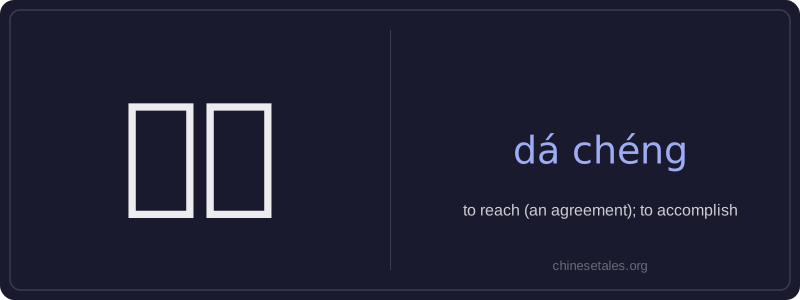
'达成' is a compound verb meaning 'to reach (an agreement)' or 'to accomplish (a goal, target, or result)'. It combines 达 (dá), meaning 'to reach, attain', and 成 (chéng), meaning 'to succeed, complete, or become'. Together, they emphasize the successful conclusion of a process—especially one involving negotiation, effort, or planning. It is commonly used in formal, professional, and everyday contexts when discussing agreements, objectives, contracts, or milestones.
This verb is transitive and requires a direct object—usually an abstract noun like 'agreement', 'goal', 'target', 'consensus', or 'deal'. It often appears in written reports, business meetings, news articles, and personal plans. While it can be used in casual speech, it carries a slightly formal or serious tone, unlike more colloquial alternatives like '做到' (zuò dào) or '实现' (shí xiàn). It is never used for physical actions or concrete achievements without an implied objective or agreement.
Example Sentences
Related Words
国语
‘Guó yǔ’ literally means 'national language'—
无论谁
‘无论谁’ (wú lùn shéi) is a pronoun meaning
不对
不对 (bù duì) literally combines 不 (bù), meani
外语
‘外语’ literally means ‘outside language’ —
违规
违规 (wéi guī) literally means 'to violate rules
亲笔
‘亲笔’ literally means ‘one’s own hand’—comb
我的
我的 (wǒ de) is a possessive pronoun meaning 'my'
短袜
‘短袜’ (duǎn wà) literally means ‘short sock