Word Explanation
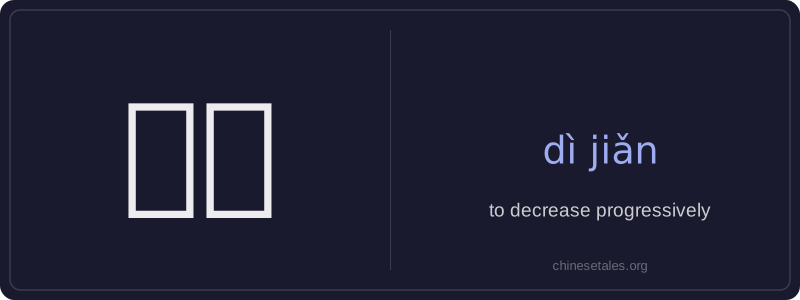
'递减' (dì jiǎn) is a verb meaning 'to decrease progressively' or 'to diminish gradually' — that is, to reduce by regular or successive amounts over time or steps. The first character 递 (dì) means 'in sequence' or 'successively', while 减 (jiǎn) means 'to reduce' or 'to subtract'. Together, they emphasize a stepwise, orderly decline — not sudden or random, but methodical and often predictable, like a countdown or scheduled reduction.
This term is commonly used in contexts involving numbers, time-based trends, statistics, finance, and science: for example, describing declining populations, diminishing resources, tapering medication doses, or decreasing temperatures over hours. It frequently appears in formal writing, reports, and technical explanations rather than casual speech. While it can stand alone as a verb, it’s also often used as a modifier before nouns (e.g., 递减趋势 — 'a progressively decreasing trend') or with aspect markers like 了 or 着.
Example Sentences
Related Words
国语
‘Guó yǔ’ literally means 'national language'—
无论谁
‘无论谁’ (wú lùn shéi) is a pronoun meaning
不对
不对 (bù duì) literally combines 不 (bù), meani
外语
‘外语’ literally means ‘outside language’ —
违规
违规 (wéi guī) literally means 'to violate rules
亲笔
‘亲笔’ literally means ‘one’s own hand’—comb
我的
我的 (wǒ de) is a possessive pronoun meaning 'my'
短袜
‘短袜’ (duǎn wà) literally means ‘short sock