Word Explanation
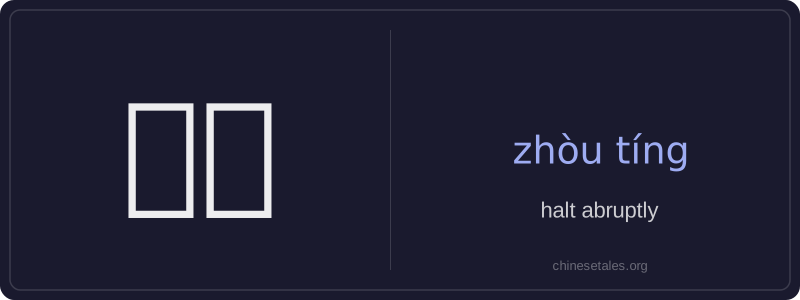
‘骤停’ is a compound verb meaning 'to halt abruptly' or 'to stop suddenly', emphasizing both the speed and unexpectedness of the cessation. The first character 骤 (zhòu) means 'sudden' or 'abrupt', often describing rapid, unforeseen changes — like a sudden downpour (骤雨) or sharp temperature drop. The second character 停 (tíng) means 'to stop' or 'to halt', conveying a complete cessation of motion or function. Together, they form a concise, formal term that stresses immediacy and finality, commonly used in medical, technical, or descriptive contexts where abrupt cessation carries serious implications.
This word is frequently found in clinical settings (e.g., cardiac骤停 for 'cardiac arrest'), safety warnings, or literary descriptions of mechanical failure or natural phenomena. It is more formal and weightier than everyday synonyms like 突然停下; it implies severity, urgency, or danger, not just surprise. Learners should note that 骤停 is typically transitive in technical usage (e.g., 心跳骤停), but can also appear intransitively with clear context (e.g., 列车骤停).
Example Sentences
Related Words
国语
‘Guó yǔ’ literally means 'national language'—
无论谁
‘无论谁’ (wú lùn shéi) is a pronoun meaning
不对
不对 (bù duì) literally combines 不 (bù), meani
外语
‘外语’ literally means ‘outside language’ —
违规
违规 (wéi guī) literally means 'to violate rules
亲笔
‘亲笔’ literally means ‘one’s own hand’—comb
我的
我的 (wǒ de) is a possessive pronoun meaning 'my'
认同
‘认同’ (tóng rèn) is a verb meaning ‘to ident