Word Explanation
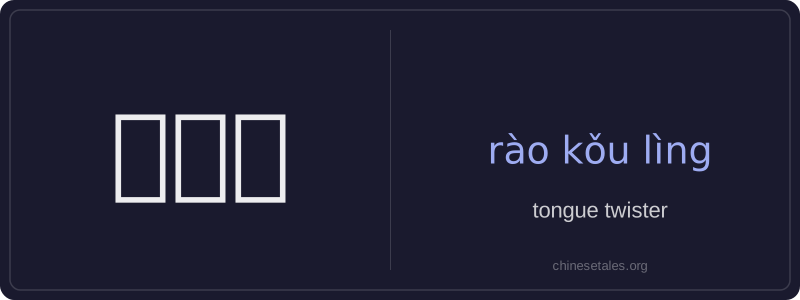
A rào kǒu lìng (tongue twister) is a short, playful phrase or sentence designed to be difficult to pronounce quickly and accurately due to repeated similar sounds, alliteration, or rapid shifts between challenging consonant clusters. The characters break down as follows: rào (to wind around), kǒu (mouth), and lìng (command or decree)—literally 'a mouth-winding command', reflecting how these phrases 'twist' the speaker’s tongue like an oral challenge.
Tongue twisters are widely used in Chinese language education to improve pronunciation, tone accuracy, and fluency—especially for learners struggling with retroflex sounds (zh/ch/sh/r) or tone distinctions. They often feature animals, food, or everyday objects, and many are passed down orally as cultural wordplay. Native speakers enjoy them as games at family gatherings or in classrooms, and some even appear in children’s songs and TV shows.
Example Sentences
Related Words
国语
‘Guó yǔ’ literally means 'national language'—
无论谁
‘无论谁’ (wú lùn shéi) is a pronoun meaning
外语
‘外语’ literally means ‘outside language’ —
面条
‘面条’ (miàn tiáo) literally means ‘flour str
认同
‘认同’ (tóng rèn) is a verb meaning ‘to ident
违规
违规 (wéi guī) literally means 'to violate rules
亲笔
‘亲笔’ literally means ‘one’s own hand’—comb
不对
不对 (bù duì) literally combines 不 (bù), meani