Word Explanation
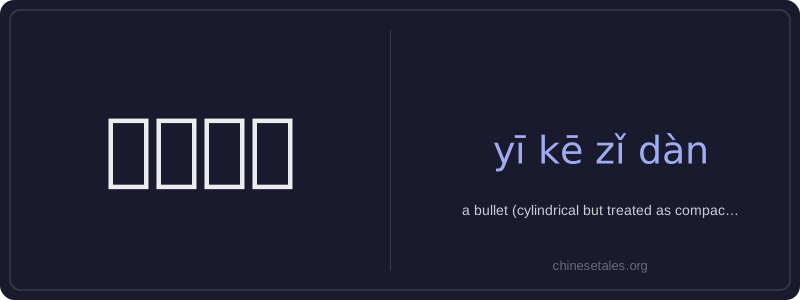
'一颗子弹' literally means 'one grain/bullet of bullet' — a fixed noun phrase meaning 'a bullet'. Though bullets are cylindrical, Chinese uses the measure word 颗 (kē), which typically counts small, round, compact objects like pills, beads, or seeds. This reflects how Mandarin categorizes objects by shape and function rather than strict geometry. The characters 子 (zǐ) and 弹 (dàn) together form the compound word 子弹 (zǐdàn), meaning 'bullet'; 一 (yī) is the numeral 'one', and 颗 (kē) is the appropriate classifier for this object.
This phrase appears in medical reports, news about accidents or violence, historical narratives, and crime fiction. It emphasizes the singular, tangible unit — often implying danger, precision, or consequence. Unlike English, where 'bullet' needs no classifier in indefinite contexts ('a bullet'), Chinese requires both the numeral and classifier: you cannot say *子弹 alone to mean 'a bullet'; it must be 一颗子弹 (or another numeral + 颗 + 子弹).
Example Sentences
Related Words
国语
‘Guó yǔ’ literally means 'national language'—
无论谁
‘无论谁’ (wú lùn shéi) is a pronoun meaning
不对
不对 (bù duì) literally combines 不 (bù), meani
外语
‘外语’ literally means ‘outside language’ —
违规
违规 (wéi guī) literally means 'to violate rules
亲笔
‘亲笔’ literally means ‘one’s own hand’—comb
我的
我的 (wǒ de) is a possessive pronoun meaning 'my'
短袜
‘短袜’ (duǎn wà) literally means ‘short sock