Word Explanation
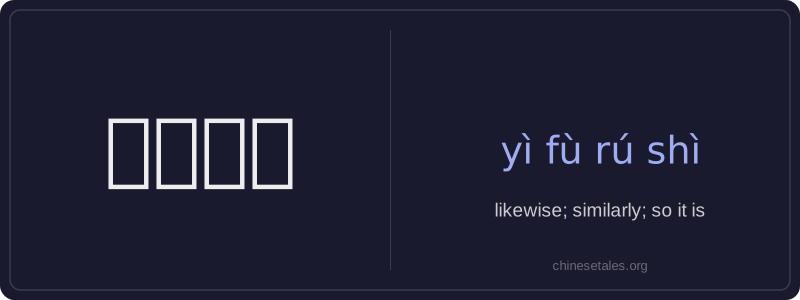
'亦复如是' is a classical Chinese adverbial phrase meaning 'likewise', 'similarly', or 'so it is'. Though composed of four characters—亦 ('also'), 复 ('again', 'likewise'), 如 ('as', 'like'), and 是 ('this', 'so')—it functions as a fixed, literary unit. Its literal breakdown suggests 'also again as this', conveying emphatic agreement or parallelism in tone and structure. It is rarely used in casual speech but appears frequently in formal writing, philosophical texts, Buddhist sutras, and literary essays to underscore continuity, inevitability, or shared truth across situations.
The phrase carries a solemn, reflective, or even resigned nuance—often implying that what holds true for one case holds true for another without exception. It’s commonly found after stating a fact or observation, then introducing a related case: 'X is thus; Y, 亦复如是.' Learners should recognize it as a stylistic marker of elevated register rather than a colloquial connector.
Example Sentences
Related Words
国语
‘Guó yǔ’ literally means 'national language'—
无论谁
‘无论谁’ (wú lùn shéi) is a pronoun meaning
不对
不对 (bù duì) literally combines 不 (bù), meani
外语
‘外语’ literally means ‘outside language’ —
违规
违规 (wéi guī) literally means 'to violate rules
亲笔
‘亲笔’ literally means ‘one’s own hand’—comb
我的
我的 (wǒ de) is a possessive pronoun meaning 'my'
面条
‘面条’ (miàn tiáo) literally means ‘flour str