Word Explanation
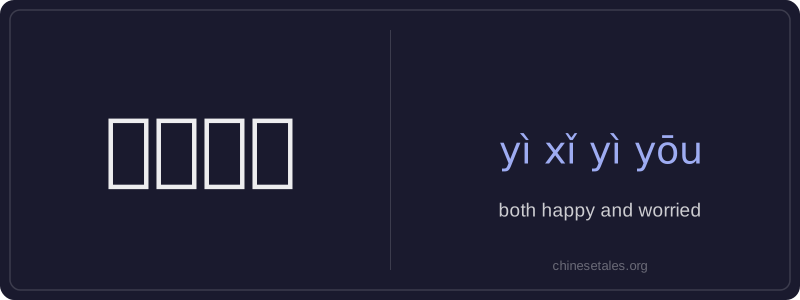
‘亦喜亦忧’ is a literary, four-character idiom meaning 'both happy and worried'—describing a mixed emotional state where joy and anxiety coexist simultaneously. Each character contributes directly: 亦 means 'also' or 'likewise', repeated to emphasize duality; 喜 means 'joy' or 'happiness'; 忧 means 'worry' or 'anxiety'. The structure mirrors classical Chinese parallelism, creating balance and contrast. It’s commonly used in formal writing, essays, news commentary, or reflective speech to convey nuanced, bittersweet feelings—such as when celebrating a child’s graduation while mourning their departure from home.
This phrase conveys emotional complexity more elegantly than simpler alternatives like 又高兴又担心. It often appears after a comma or in apposition to a noun or clause (e.g., ‘这件事令人亦喜亦忧’), and rarely functions as a predicate on its own without a verb like ‘令人’, ‘使人’, or ‘显得’. Though grammatically adjectival, it behaves like a predicative expression requiring a linking context.
Example Sentences
Related Words
国语
‘Guó yǔ’ literally means 'national language'—
无论谁
‘无论谁’ (wú lùn shéi) is a pronoun meaning
不对
不对 (bù duì) literally combines 不 (bù), meani
外语
‘外语’ literally means ‘outside language’ —
违规
违规 (wéi guī) literally means 'to violate rules
亲笔
‘亲笔’ literally means ‘one’s own hand’—comb
我的
我的 (wǒ de) is a possessive pronoun meaning 'my'
面条
‘面条’ (miàn tiáo) literally means ‘flour str