Word Explanation
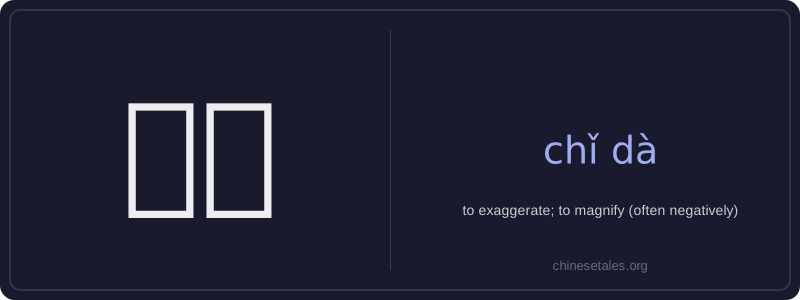
‘侈大’ is a verb meaning to exaggerate or magnify something beyond reality—often with a negative connotation, implying distortion, overstatement, or unnecessary inflation. The character 侈 (chǐ) originally meant 'extravagant' or 'excessive', carrying a sense of immoderation; 大 (dà) means 'big' or 'large'. Together, they form a compound suggesting the act of making something appear larger, more serious, or more significant than it truly is—especially in emotional, rhetorical, or descriptive contexts.
This word is commonly used in formal writing, critical commentary, or psychological analysis—for example, when describing how someone blows a minor issue out of proportion or inflates their own achievements. It is not used for neutral or positive amplification (e.g., ‘enlarging an image’), nor is it interchangeable with simple intensifiers like 很 or 非常. Its tone is evaluative and often implies criticism or caution about perceptual bias or rhetorical manipulation.
Example Sentences
Related Words
国语
‘Guó yǔ’ literally means 'national language'—
无论谁
‘无论谁’ (wú lùn shéi) is a pronoun meaning
外语
‘外语’ literally means ‘outside language’ —
不对
不对 (bù duì) literally combines 不 (bù), meani
违规
违规 (wéi guī) literally means 'to violate rules
亲笔
‘亲笔’ literally means ‘one’s own hand’—comb
我的
我的 (wǒ de) is a possessive pronoun meaning 'my'
面条
‘面条’ (miàn tiáo) literally means ‘flour str