Word Explanation
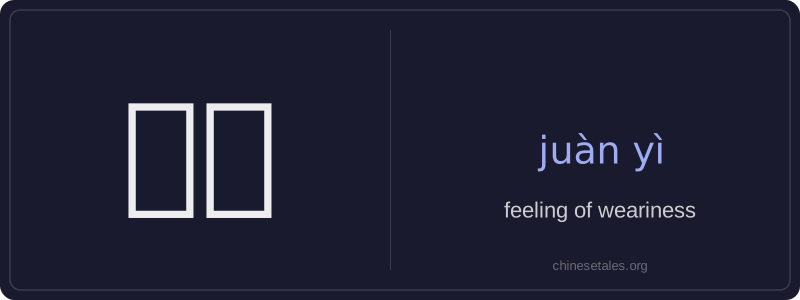
‘倦意’ is a compound noun meaning ‘a feeling of weariness’ or ‘drowsiness,’ often arising from physical exhaustion, mental fatigue, or prolonged activity. The first character 倦 (juàn) means ‘tired,’ ‘weary,’ or ‘fatigued,’ carrying a strong connotation of depletion—both bodily and psychological. The second character 意 (yì) means ‘intention,’ ‘idea,’ or ‘feeling,’ but here functions as a nominal suffix that transforms the adjective into an abstract noun denoting a subjective internal state. Together, 倦意 doesn’t refer to overt sleepiness like 困意 (which is more about needing sleep), but rather a subtle, creeping sense of lethargy or loss of energy—often noticed during quiet moments or after sustained effort.
This word is commonly used in written Chinese and formal spoken contexts, such as literature, health reports, or personal reflections. It appears frequently in descriptions of recovery, aging, overwork, or seasonal changes (e.g., spring fatigue). Unlike colloquial terms like 累 (lèi, ‘tired’), 倦意 carries a gentle, slightly literary tone and implies a passive, inward awareness rather than active complaint.
Example Sentences
Related Words
国语
‘Guó yǔ’ literally means 'national language'—
无论谁
‘无论谁’ (wú lùn shéi) is a pronoun meaning
外语
‘外语’ literally means ‘outside language’ —
不对
不对 (bù duì) literally combines 不 (bù), meani
违规
违规 (wéi guī) literally means 'to violate rules
亲笔
‘亲笔’ literally means ‘one’s own hand’—comb
我的
我的 (wǒ de) is a possessive pronoun meaning 'my'
面条
‘面条’ (miàn tiáo) literally means ‘flour str